Desktop game · Personal project
Animal Tactics
An auto-battler for desktop, the genre Teamfight Tactics made popular: draft animal spirits from a shop the whole lobby shares, combine copies into stronger forms, build trait synergies on a hex board, and outlast seven AI opponents. It's in development, and a web release may follow.
- Role
- Design and development
- Timeline
- Version 0.9 · In development
- Stack
- Godot 4.7GDScriptDesktop
38
Animal spirits, each with its own ability
7
AI opponents, at three difficulties
~33,000
Checks in the headless test suite
The game
Each round starts with a planning phase: collect income, buy from a shop shared by all eight players, reroll, level up, and arrange your board. Then the fight plays out on its own, against another player or a round of monsters, and the loser takes damage. Three copies of an animal combine into its Awakened 2-star form, and three of those into a Sovereign 3-star. The last player standing wins.
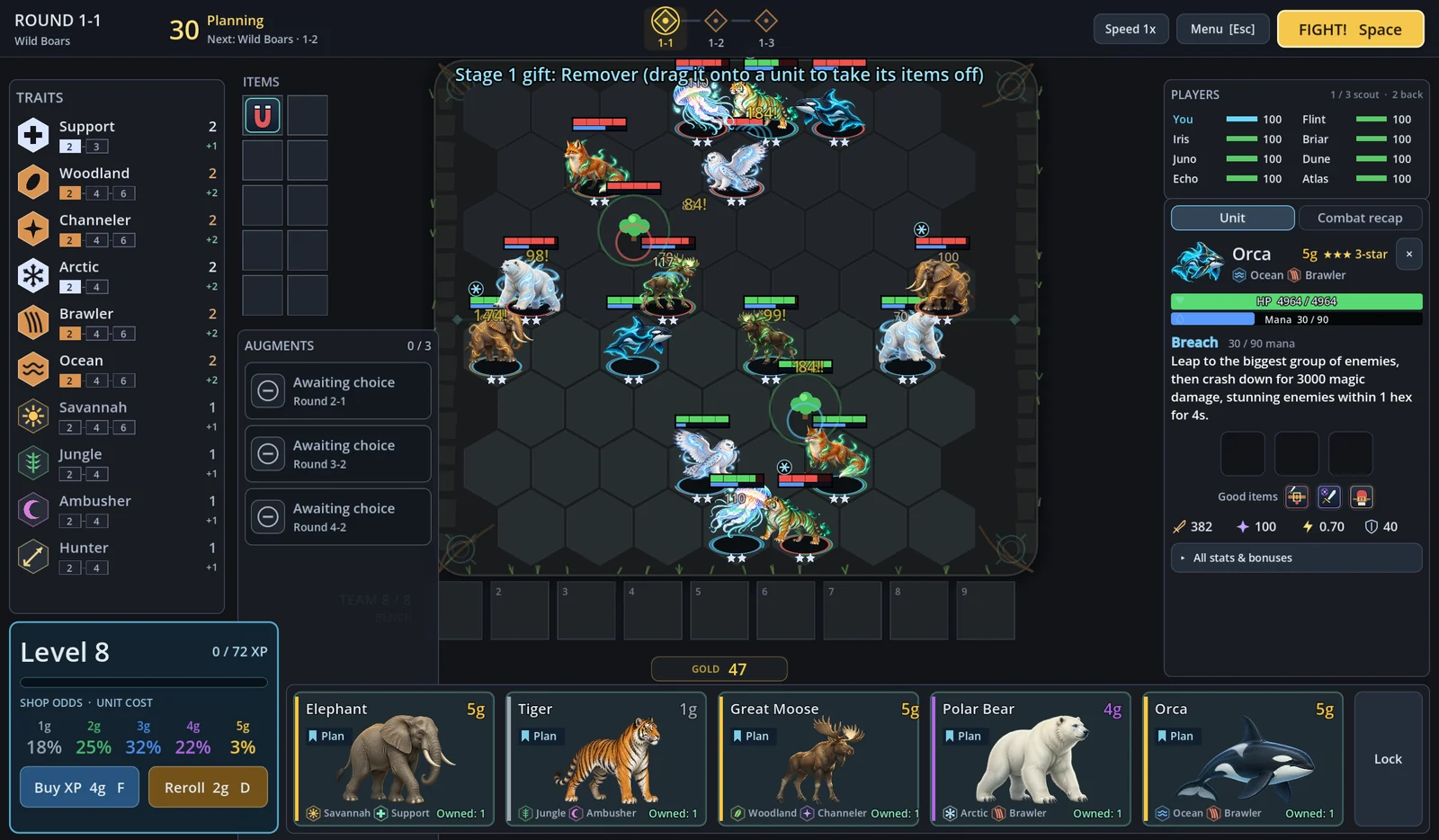
There are 38 animal spirits across five habitats, eight roles and two traits that belong to a single animal, and each animal fights its own way: the Tortoise hides in its shell, the Hippo sends enemies running, the Orca leaps into the biggest group of enemies. Most traits change how a fight plays rather than adding stats: Savannah animals get stronger standing together, Woodland grows a healing Sapling, and Arctic attacks build Frost that freezes. Around them sit 36 items built from eight components, augments you pick three times a game, a shared draft every stage, and a Season that changes one rule for the whole game.
Seven bots fill the other seats, at Easy, Normal or Hard. Each picks traits to focus on, levels on a schedule, keeps gold back for interest, and rolls for upgrades when its health gets low; Hard bots also build toward trait breakpoints.
How I built it
I built Animal Tactics with Claude Code and OpenAI's Codex, working from a design document that keeps every rule and number in one place. The first commit was already a complete game, the first nine releases, 0.1 to 0.6.1, landed within a day of starting it, and 0.9 followed three days later.
The animal art was generated with ChatGPT's image generation: one sheet per animal with its three forms, which the game cuts apart and animates in code. The item icons are SVGs drawn by a small script, and the 25 sound effects are synthesized from scratch, with no recorded samples.
Fights you set up but don't control
Combat is a fixed-step simulation at 30 ticks a second, seeded so the same fight always plays out the same way. Units walk the hex grid around each other, build mana and cast, and the two sides take turns acting first each tick so neither gets a head start.
The game state and the simulation are plain objects with no scene attached. During combat every fight in the lobby runs side by side, the board draws whichever one you're watching, and the tests play whole eight-player games with no window at all. Rules, combat, every ability, item and trait, and eight full games add up to about 33,000 checks, and separate UI tests drive the real scene with simulated clicks and drags.
A deterministic simulation is also what makes an online lobby practical later, since a server could run the same code.
Balancing 38 animals
All the tuning lives in data files: shop odds by level, how many copies of each unit the shared pool holds, the economy, and every unit's stats. Pricier animals start stronger and grow more with each star, from 1x, 1.8x and 3.24x for 1-costs to 1x, 1.9x and 4.6x for 5-costs.
To check the numbers, a harness fights role-matched teams against each other, and every animal wins between 44% and 57% of its fights against others of the same cost. When version 0.9 gave nine traits real mechanics, each was measured against its old version by running the same fights with the trait on and off, then across 96 full bot games, where the nine traits' average placements landed between 4.33 and 4.92.
Built for a desktop screen
The game opens on a title screen: pick the bots' difficulty and a planning timer (45 seconds, 30, or untimed), read a 12-step picture guide, browse every animal in the spirit gallery, or look back at your match history with stats for each animal and trait. First-game tips explain each new idea the first time it comes up, and the end screen shows all eight players' final teams.
In a game, the layout works at any window size, with panels pinned to the edges and the board centered. Tooltips appear the moment you hover an item, trait or shop card, the item bench lists the recipes you can build right now, and most actions have a key: D to reroll, F to buy XP, E to sell, W to move a unit between bench and board. Clicking a unit pins its live stats, and a combat recap shows damage dealt, damage taken, and healing and shields for every unit.
Where it stands
Animal Tactics is at version 0.9 and runs on desktop. Next on the list: more trait mechanics and Seasons, keybinds, saving a game in progress, and possibly online play. A web release may follow. The game was called Unit Tactics until version 0.8.1, and the journal below covers every release so far.
Screenshots
Inside the game
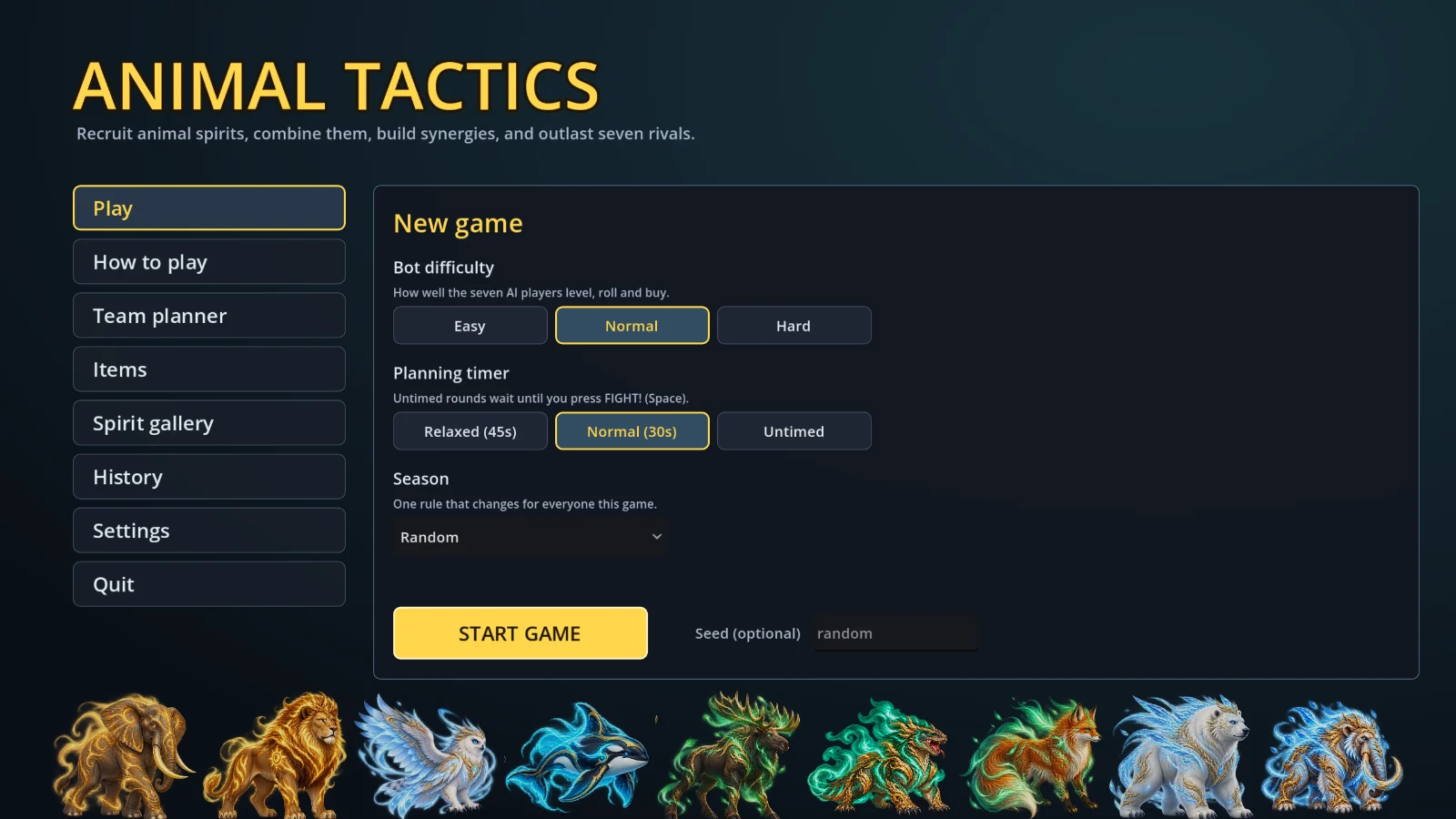
The title screen, with options for a new game. 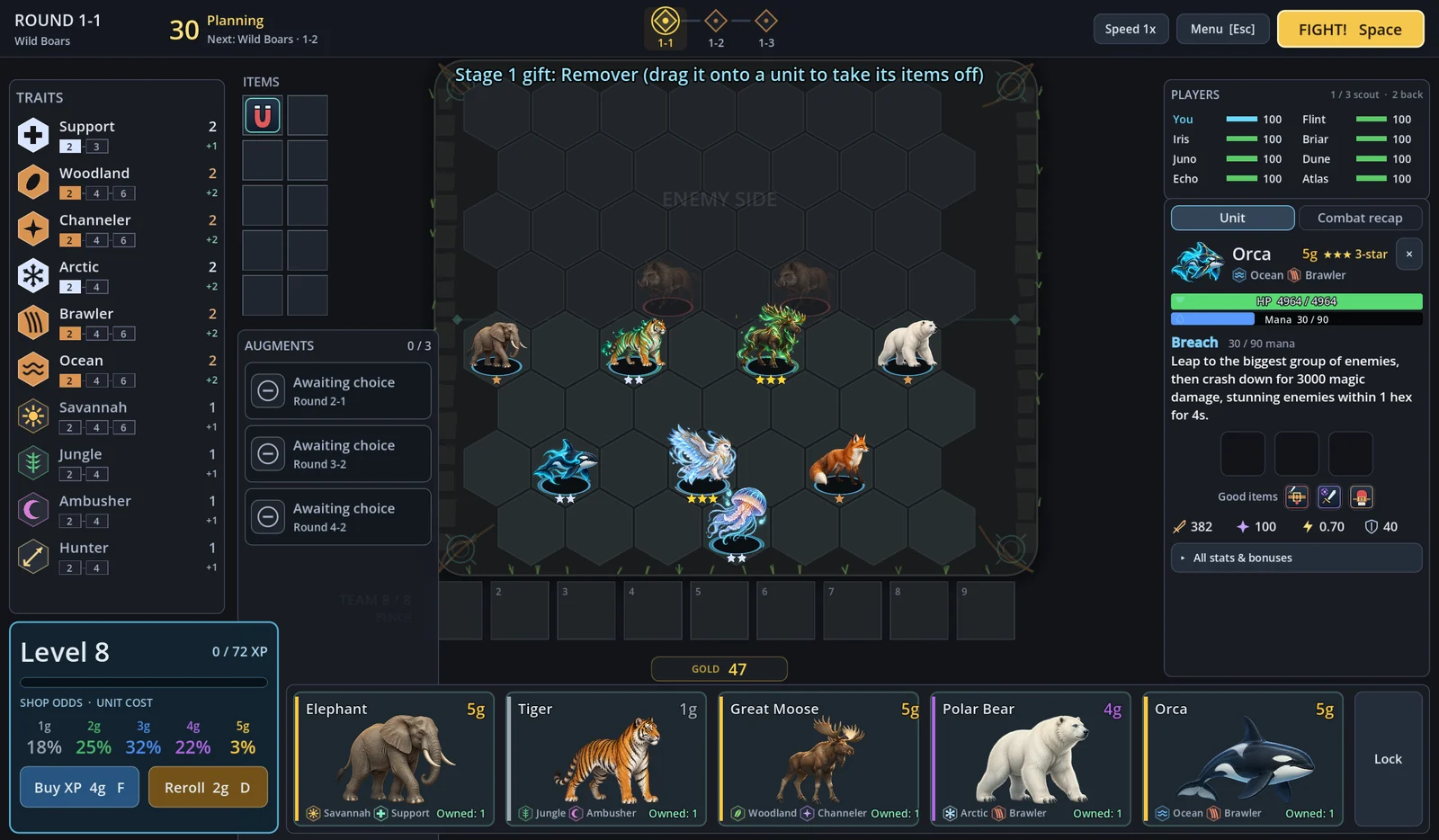
Planning a round, with a unit pinned on the right. 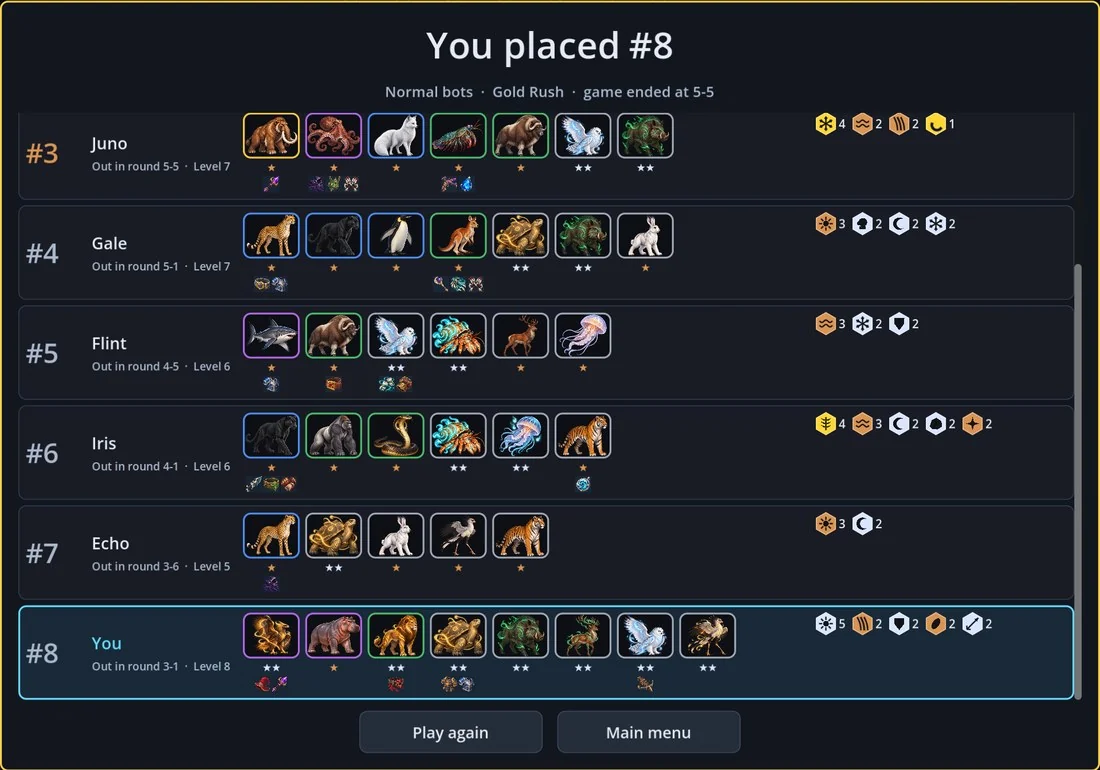
The final standings show every player's team. 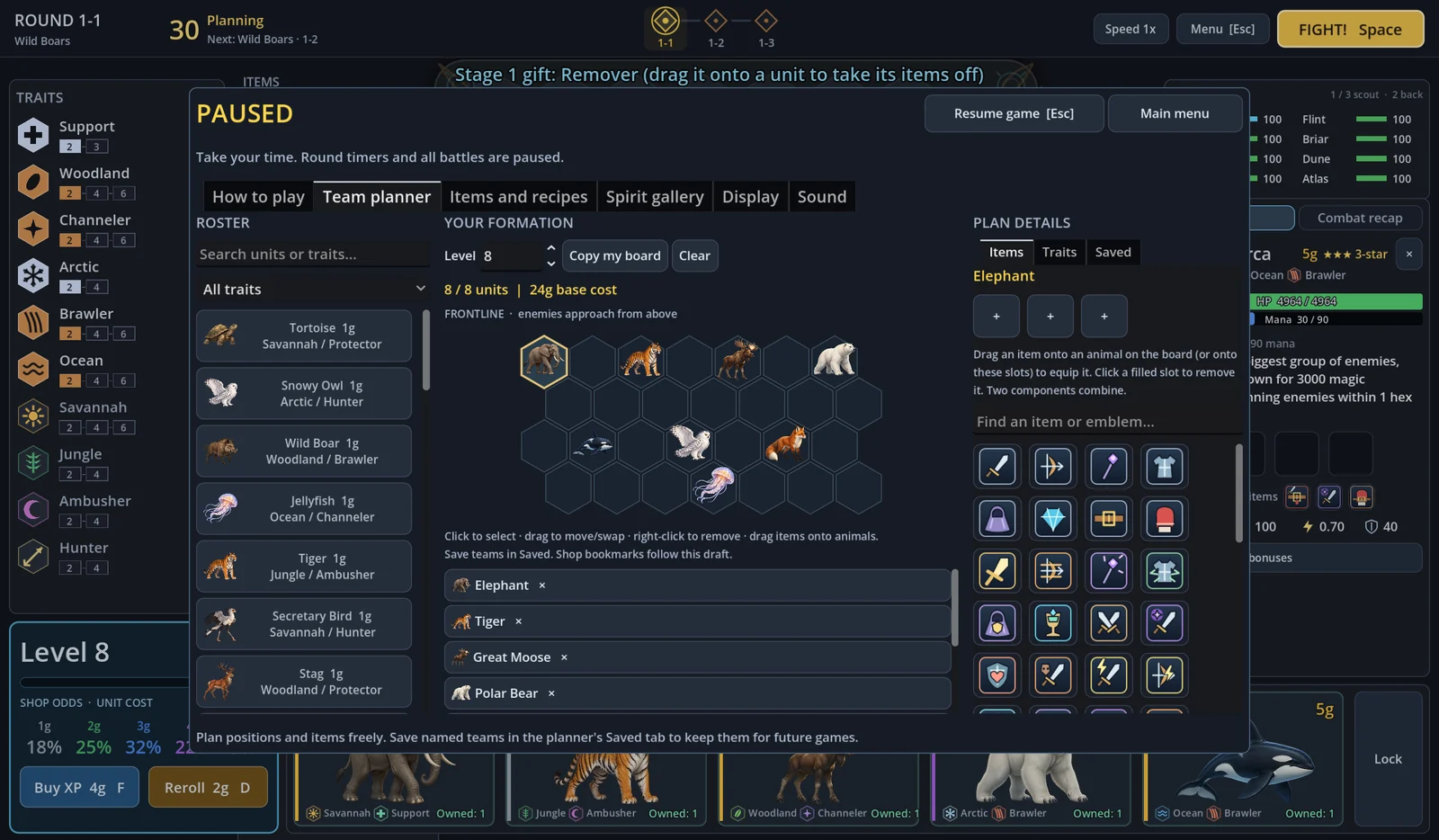
The team planner, with positions and items.
Devlog
Animal Tactics in the journal
Animal Tactics 0.9: traits that change fights, and Seasons
Nine traits now change how a fight plays instead of adding stats, every game rolls one of eight Seasons, and the title screen keeps a history of your games. Plus music and sound.
3 min read
Animal Tactics 0.8: a title screen and a new name
The game now starts on a title screen with bot difficulty and timer options, teaches itself with first-game tips, ends with full standings, and has a new name.
2 min read
Unit Tactics 0.7: belts, gloves and ten new animals
Two new components bring the item list to 36, two new classes and two one-animal traits join the roster, and ten new animals take it to 38.
2 min read
Unit Tactics 0.6: 28 animals, 28 abilities
Every animal now fights its own way, stats scale with cost and were tuned with a fight harness, and a polish pass reworks the board, shop, traits and unit panel.
2 min read
Unit Tactics 0.5: augments, special items and a shared draft
Three times a game you pick an augment that lasts the whole game. Spirit Totems make emblems, new tools rework your items, and every stage has a shared draft.
2 min read
Unit Tactics 0.4: Wild Spirits
The placeholder tokens become 28 painted animal spirits with three forms each, plus a pause menu, a team planner, fairer loot, shop odds and a round timeline.
2 min read
Unit Tactics 0.3: any window, instant tooltips, live scouting
The layout works at any window size, tooltips appear the moment you hover, and scouting now shows every fight live, side by side.
1 min read
Unit Tactics 0.2: items, scouting and a damage chart
Monster rounds now drop item components that combine into 21 completed items, you can scout any player's board, and a live chart shows who's doing the damage.
1 min read
Unit Tactics 0.1: a playable auto-battler
The first commit is already a whole game. Draft units from a shared shop, build traits on a hex board, and outlast seven AI opponents in fights that play themselves.
2 min read